
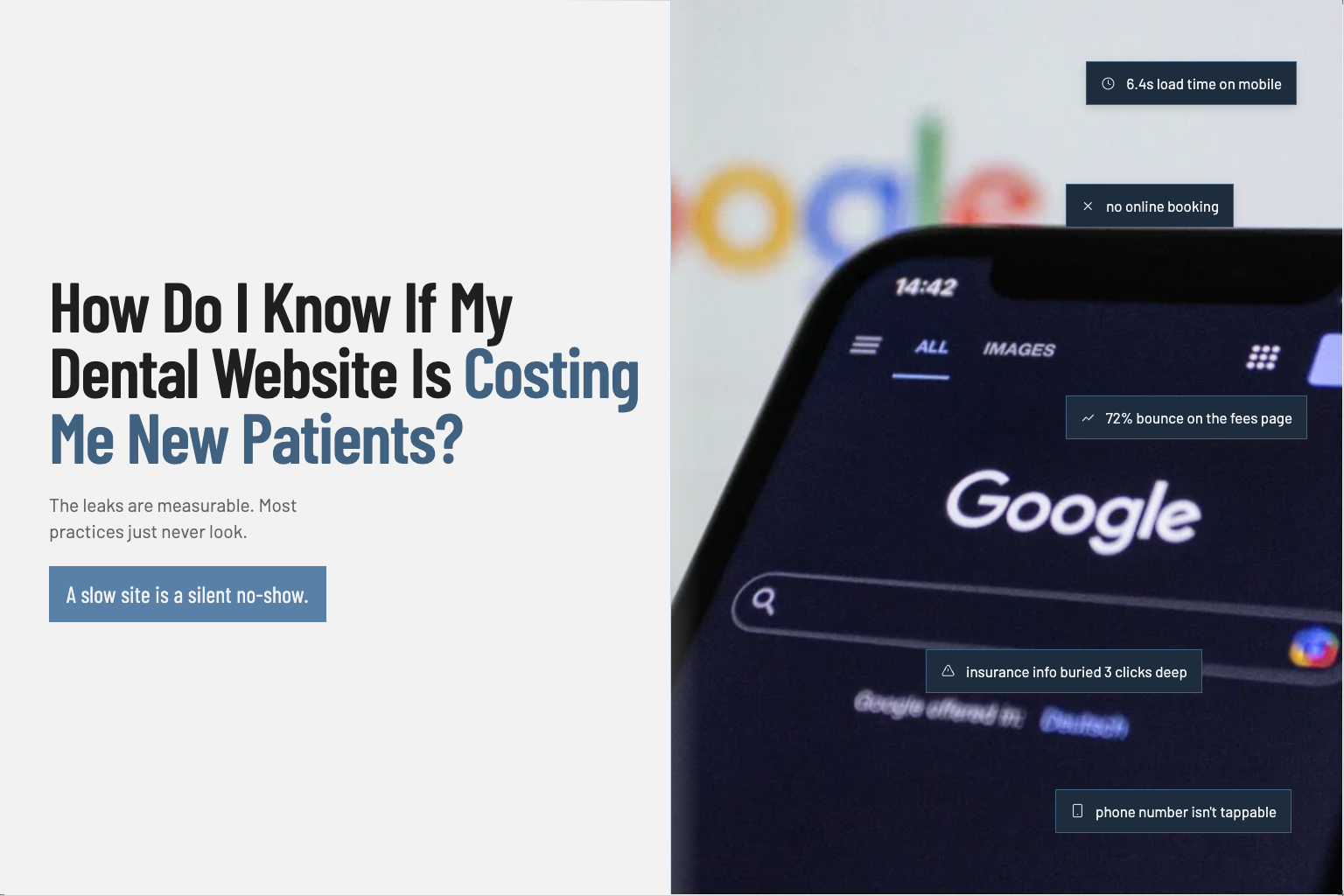
How many potential patients is your website losing every week? The number is almost always bigger than dentists suspect, and it stacks up quietly month after month. A dental website that looks perfectly fine at first glance can still leak new patients every day. Certain design choices, technical issues, and content gaps push potential patients toward the next practice on the search results page before they even reach your phone number.
Key Takeaways
- Many dental websites lose new patients before those patients ever call the office.
- Slow load times, poor mobile design, and outdated content are common culprits.
- Modern patients decide within seconds whether to stay on a site or leave.
- AI-driven search systems can quietly skip websites that lack proper structure.
- A professional website audit reveals exactly where the gaps are hiding.
Why Isn't My Dental Website Getting New Patients?
When traffic comes in, but new patient calls do not, the cause is rarely a single issue. A website that fails to convert visitors typically has several smaller problems adding up. Steady traffic without conversion, low phone call volume despite good search rankings, or a drop in new patient numbers over the past year are all signs that something on the site itself is quietly holding growth back. The specific culprits often surprise dentists once they are identified.
Some of the most common friction points involve slow page load speed, confusing navigation, weak calls to action, and content that reads like it was written for other dentists rather than for patients. Any one of these on its own could cost a practice several new patients a month, and it is rare to find only one at a time.
What Modern Patients Notice Within Seconds
Patients make snap decisions online. Studies of digital user behavior consistently show that most visitors form a judgment about a website within the first few seconds of landing on it. Certain elements shape that first impression more than others:
- Load time: A site that takes more than a few seconds to load loses a large share of visitors before they even see the homepage.
- Mobile experience: Most patients search on their phones. A site that looks fine on a desktop may still feel clunky on mobile.
- Trust signals: Real photos, current reviews, and credentials all shape whether a patient believes the practice is right for them.
- Clear next steps: Patients need to see where to call, where to book, and where to contact you without hunting through the site.
- Visual quality: Stock photos, dated design, and cluttered layouts erode confidence before a patient reads a single word.
The Hidden Costs Beyond Lost Patients
The lost patients are the most visible cost, but they are not the only one. Google's ranking algorithms increasingly reward sites that meet modern performance standards and penalize those that do not. A dated website makes paid ad campaigns less effective, since the ads drive traffic to a page that fails to convert. AI search systems, which are becoming a bigger part of how patients discover local dentists, also skip past websites that lack the right kind of structure and content signals.
Each of these compounds over time. A single slow page might not seem catastrophic, but its ripple effects on ad performance, search visibility, and patient trust can quietly reshape years of growth potential.
Frequently Asked Questions
How can I tell if my dental website is outdated?
The clearest test is age. A dental website that has not been meaningfully updated in three or four years almost always falls short of current patient expectations, with tell-tale signs like slow load speeds, clunky mobile behavior, and hard-to-find calls to action.
Does website speed really matter for dental practices?
It matters more than most dentists realize. Even a one or two-second delay in load time can send a meaningful share of visitors to a competing practice, and Google's algorithms actively factor page speed into local search rankings.
Why isn't my dental practice showing up on Google?
Local search rankings depend on a combination of technical site structure, content quality, Google Business Profile optimization, review volume, and a growing list of AI-visibility signals. When any of these lag behind, the practice can quietly slide down the results even if the actual dentistry is excellent.
Finding Out What Your Website Is Actually Doing
The frustrating part of a website that is quietly costing new patients is that most of the problems are invisible from the inside. The site owner sees the same design and layout every day, and the visitors who leave never say why. A professional audit changes that by looking at the site the way search engines, AI models, and modern patients actually see it. The result is a clear picture of which elements are working, which are hurting growth, and what the highest-value improvements would be.
If you want a clear look at how your website is performing and where it may be leaking new patients, schedule a consultation with Dentist Nerds.